
The Six‑Yard Manuscript: The Sari as Bengal’s Living Text - Dr. Mostofa Sarwar
Akbar Haider Kiron প্রকাশিত: ২৯ জুলাই, ২০২৬, ০৩:২৪ এএম

The Six‑Yard Manuscript: The Sari as Bengal’s Living Text
Mostofa Sarwar
Distinguished guests, fellow writers, and lovers of the written word,
Welcome to this magnificent celebration of literature. I am deeply honored to inaugurate this celebration. My heartfelt thanks to Dr. Dhanonjoy Saha and Bengali International Literary Society for organizing such an event.
When we look around a book fair, we see hundreds of volumes bound in cardboard, leather, and paper. But today, I want to speak to you about a different kind of text—one that is unbound, fluid, and exactly six yards long. I want to talk about the sari, not merely as a garment of cotton and silk, but as an ancient, living manuscript of Bengali culture and literature. 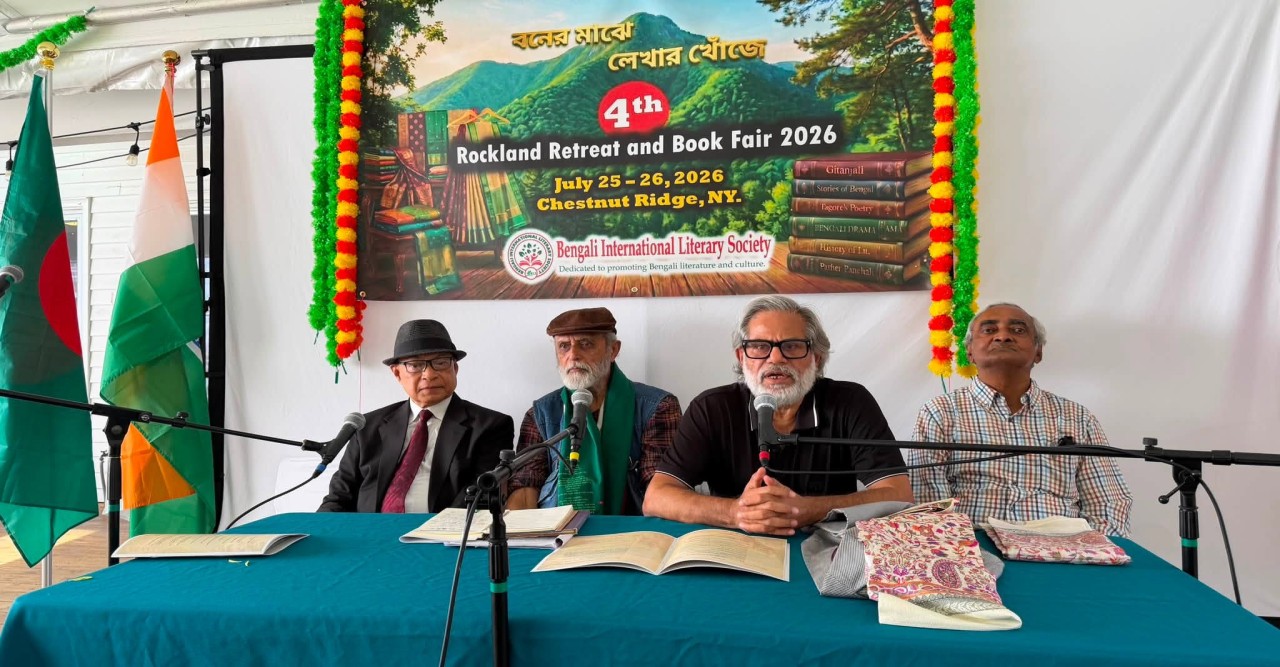 In Bengal, the sari is a profound canvas of identity, memory, and creative expression. If you want to trace the history of our delta—its weather, its political revolutions, and its deepest psychological shifts—you do not only look at our history books. You look at how our women drape their saris, and how our writers capture that movement in ink.
The Landscape Woven into Thread
The very geography of Bengal is mirrored in the distinct textures of its saris. Our weavers have always been poets who write with a shuttle and loom instead of a pen.
Think of the Dhakai Jamdani. It is a logic-defying, translucent marvel where intricate geometric and floral motifs seem to float on air. It mimics the misty, translucent mornings of the Bengal delta. 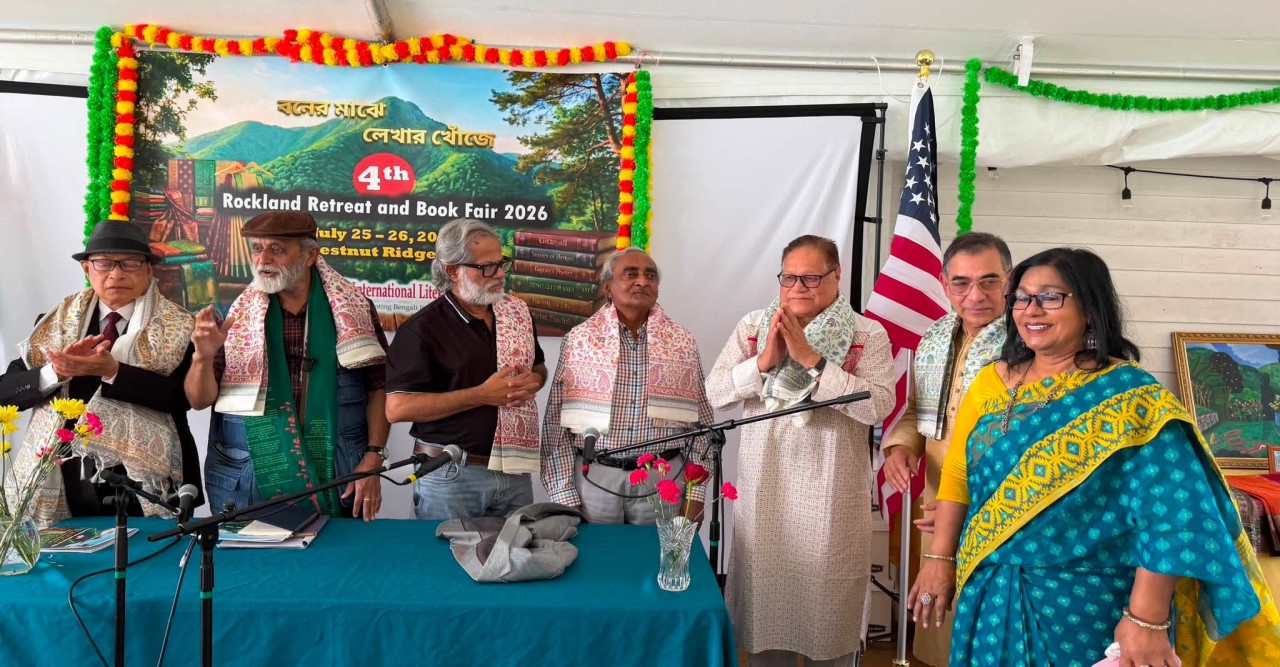 Think of the Baluchari of Murshidabad, where the pallu—the decorative end of the sari—functions literally as a narrative scroll. Long before modern graphic novels, Baluchari weavers were etching history into silk, depicting courtly nawabs, European steamships, and scenes from ancient epics.
And, of course, the crisp, lightweight cotton Tant, which is the very breath of daily life, alongside the striking red-and-white Garad that defines the spiritual heartbeat of our festivals.
A Symbol of Defiance and Rebirth
But literature and culture are never static; they are born from struggle. The sari we see today is a product of profound socio-political evolution.
In the late nineteenth century, a quiet revolution took place within the Jorasanko Tagore family. Jnanadanandini Devi looked at the traditional way the sari was draped—practical for the village, but restrictive for a modernizing world. By introducing the blouse, the petticoat, and the pinned left-shoulder drape, she created the Brahmika style. This was not a mere fashion statement; it was an act of liberation. It gave Bengali women the physical and social mobility to step out of the inner courtyards (antaral) and enter public, academic, and literary spaces.
During the Swadeshi movement, fine British Manchester cotton was cast aside. The rough, locally woven handloom tant sari became a sacred uniform of resistance. Women chose the coarse, heavy touch of local cotton over imported luxury. In doing so, they rewrote the economic destiny of Bengal. The sari became a symbol of sovereignty.
From the Delta to the Global Stage: A Personal Interlude
This cultural sovereignty does not stop at the borders of Bengal; it travels across oceans, carrying our heritage into the most unexpected spaces.
I remember a deeply personal moment from 2019. My wife, Dr. Syeda Sarwar, MD, attended the Endymion's Extravaganza Ball in the Superdome of New Orleans. She wore a magnificent, traditional Kathan Benarasi sari. We were seated at the Head of the Table alongside other VIP guests, including US Congressman. Senator, Hollywood stars, and legendary singers. For the first time in the long, storied history of the New Orleans Mardi Gras Balls, a sari was worn to the gala.
One of the world’s largest indoor events, with 20,000 attendees! The room was filled with evening gowns and tuxedos, yet it was the timeless elegance of the Benarasi sari that captivated the guests, drawing immense praise. In that massive arena, the sari was a luminous text of our heritage, gracefully asserting its presence on the global stage.
The Fabric of the Literary Imagination
When we turn to the pages of Bengali literature, the sari is rarely passive. It functions as an extension of a character’s soul, a boundary marker of desire, and a structural anchor of social order.
The famous modern thinker René Girard suggested that human beings rarely desire anything in isolation—we copy our desires from one another, and we build societal rituals to manage the tension between individual passion and collective rules.
We see this beautifully illustrated in the realism of Rabindranath Tagore. In Chokher Bali, the young widow, Binodini, is forced by society to wear a borderless, unblemished white sari. This white fabric is designed by society to act as a shroud, signaling that she must remain outside the world of human desire to protect the community from disruptive passion. It is the uniform of a ritual exile.
We see it also in the pastoral warmth of Bibhutibhushan Bandyopadhyay, where the image of a rural mother wiping her child's face with the cool, worn-out tail end of her cotton sari—the bnaachlor (বনাচলোর)—is the ultimate sensory metaphor for maternal comfort and safety.
The Erotic and Modern Rendition
But the literary journey of the sari moves far beyond classical modesty and domesticity. It transitions into the realm of raw, modern consciousness and intense sensuality.
In my own poem, "A secret note to Saki," which has been accepted for publication in Ellipsis—the literary journal published by LSU New Orleans—I sought to explore a more visceral, erotic rendition of this garment. The poem captures an ecstatic, almost mystical intoxication where the physical and the ethereal collide:
"Ah! The darkness that lingers from eternity / in the lovely folds of your April saree... / Mesmerized hands, with lightning speed, / beat saree’s lingering darkness."
Here, the sari is no longer a garment of concealment. Its folds contain an infinite, eternal darkness—a space of profound mystery and unbridled passion where the lover navigates the depths of ecstasy and desire.
Subodh Sarkar’s "Sari"
This brings us beautifully to the contemporary literary landscape. We are profoundly honored to have with us as our chief guest for these festivities, the eminent poet Subodh Sarkar, who has traveled all the way from Kolkata.
In his celebrated poem, "Sari," Professor Dr. Subodh Sarker strips away the mere ornamental value of the fabric. He exposes the sari as a deeply political and emotional landscape, a witness to the struggles, vulnerability, and resilience of women. In his verses, the sari becomes a living breathing entity, mirroring the tensions of the modern world. His presence here today bridges the geography of Kolkata and New Orleans through the shared language of our poetry.
Conclusion: The Unbroken Thread
As we open this Book Fair, let us remember that literature is not confined to the printed page. It lives in our traditions, our memory, our music, and our attire.
Today, the sari remains a vibrant, evolving language. Whether it is an eco-conscious handloom worn at a literary seminar, a dazzling Benarasi in a New Orleans ballroom, or a vivid image in contemporary poetry where the rhythm of the loom aligns with the heartbeat of a shifting world, this fabric continues to bridge our past and our future.
It is a six-yard-long poem that Bengal has been writing for centuries—a poem of resilience, elegance, and unyielding identity.
Thank you, and may this Book Fair inspire you to read the many beautiful texts that surround us.
(Inaugural speech by Dr. Mostofa Sarwar, Professor Emeritus and former Vice Chancellor and Provost, at the 4th Rockland Book Fair and Retreat, organized by the Bengali International Literary Society (BILS), on July 25-26, 2026, at the Threefold Educational Foundation Center, 285 Hungry Hollow Road, Chestnut Ridge, NY 10977.)